
| Summary: ECS Wellness presents an integrative model for supportive oncology care centered on the endocannabinoid system. By combining medical cannabis therapy with lifestyle medicine and mind-body practices, ECS Wellness helps patients manage pain, fatigue, sleep issues, and emotional distress alongside conventional cancer treatment. |
Understanding that supportive oncology care is more than an academic field, it reflects a community of clinicians, researchers, advocates, patients, and caregivers working toward one mission: a better future for people living with cancer. Since many cancers present complex treatment paths, traditional oncology alone cannot address the full burden patients carry. Supportive care must be creative, adaptable, and rooted in the human experience.
ECS Wellness is committed to showing how holistic interventions informed by the endocannabinoid system can strengthen patient well-being throughout cancer treatment. Our mission is threefold:
- To demonstrate that ECS-based supportive care enhances oncology rather than replaces it.
- To introduce integrative methods that ease treatment burden and build resilience.
- To remind healthcare teams that behind every diagnosis is a person deserving comfort, dignity, and compassion.
Our goal is to spark meaningful conversations and collaborations that help shape the next generation of patient-centered supportive oncology care.
Oncology: The Clinical Landscape
Epidemiology
Cancer includes a wide spectrum of diseases arising from different tissues, blood, bone, organs, and connective structures. Due to this diversity, many cancer types remain understudied compared to the most common ones. Annually, 16,000 new cases are diagnosed in the United States.
Clinical Challenges
Early symptoms often go unnoticed or mimic benign conditions, leading many patients to receive a diagnosis only once the disease has progressed. Treatment usually involves a combination of:
- Surgery
- Chemotherapy
- Radiation therapy
These treatments are essential but can be taxing, often causing nausea, neuropathy, fatigue, sleep disruption, and long-term complications. Relapse, long recovery periods, and the emotional weight of treatment add to the challenge.
Patient Impact
Patients commonly experience fear, insomnia, appetite changes, mood disruption, and overwhelming fatigue. Families often struggle to manage appointments, side effects, and daily responsibilities. Supportive care becomes crucial, not optional. Without it, patients may complete treatment but remain emotionally and physically depleted.
The Endocannabinoid System (ECS) and Its Role in Supportive Oncology

Core Functions of the ECS
The endocannabinoid system is the body’s internal balancing network. It is involved in nearly every process that affects cancer patients’ well-being, including:
- Sleep and circadian rhythm
- Appetite, digestion, and nausea control
- Pain perception and inflammation
- Emotional regulation and stress response
- Immune system modulation
The ECS serves as a bridge between the brain and the body, adjusting how we react to physical and emotional stressors.
Disruption in Cancer Treatment
Cancer therapies, while effective, often disturb normal physiology. Chemotherapy can trigger nausea and neuropathy. Radiation may lead to inflammation, sleep disturbances, and fatigue. Stress hormones may spike for months, affecting appetite, mood, digestion, and immune function.
Many of the common side effects that diminish quality of life are closely tied to ECS imbalance.
Therapeutic Potential
Medically guided stimulation of the ECS using cannabis or phytocannabinoids may help restore balance. Clinical observations and early research suggest potential benefits such as:
- Reduced pain intensity
- Improved appetite and digestion
- Better sleep quality
- Decreased anxiety
- Enhanced emotional stability
ECS-informed supportive care is not about replacing oncology treatment. It is about strengthening patients so they can tolerate treatment better, feel more at ease, and maintain daily function.
ECS Wellness Philosophy & Model of Care
Integrative Approach
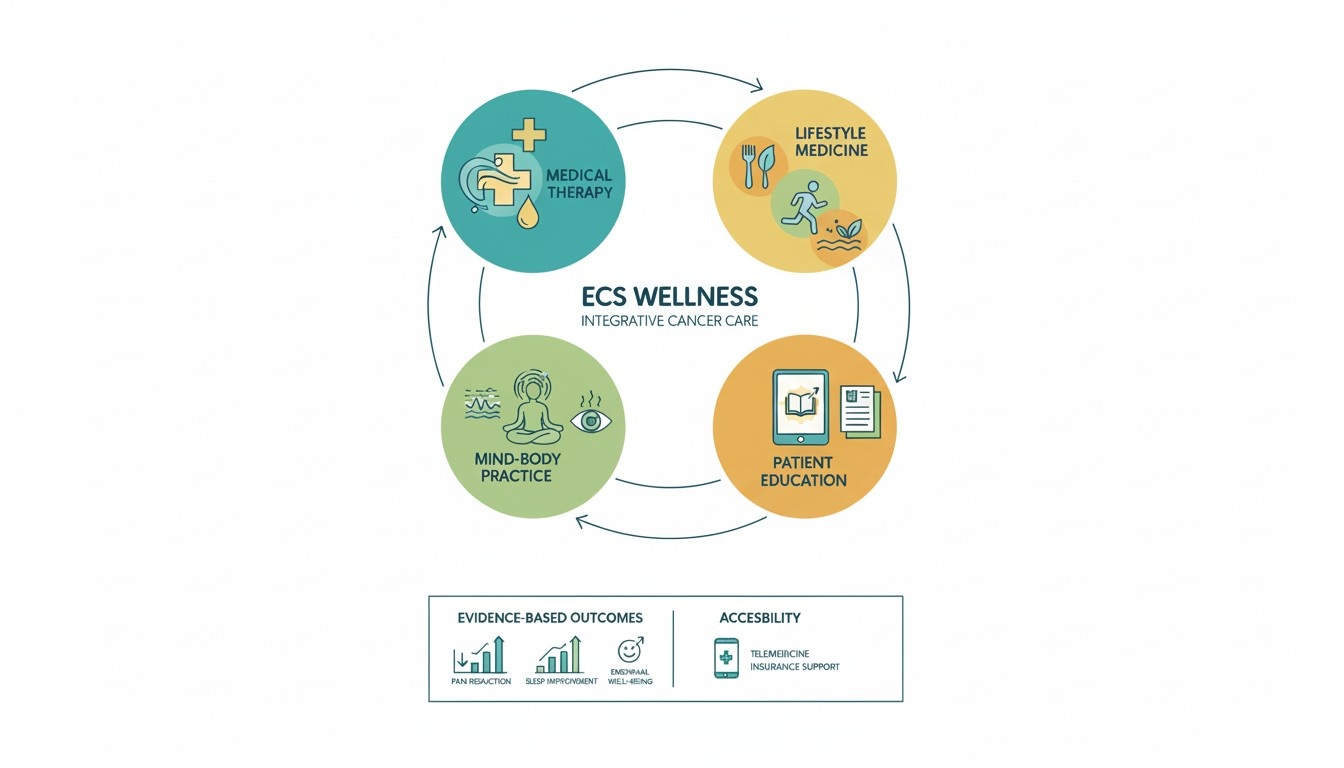
ECS Wellness offers supportive care that aligns with oncology treatment plans. Our model includes:
- Medical cannabis therapy: relief for pain, nausea, anxiety, and insomnia
- Lifestyle medicine: whole-food nutrition, movement, and stress reduction
- Mind-body practices: meditation, breathing techniques, mindfulness
- Patient education: helping patients understand their bodies and take active roles in their care
Evidence-Based Practice
Care is measured through NIH-endorsed Patient-Reported Outcome Measures (PROMs), tracking:
- Pain levels
- Sleep quality
- Emotional well-being
- Functional ability
This ensures that each patient’s lived experience shapes their care plan.
Accessibility
Working with MassHealth and major insurers supports affordability. Telemedicine extends access to underserved and rural communities.
Integration Into Multidisciplinary Oncology Care
Part 1 | Diagnosis and Primary Treatment
Oncology Advances: Improved diagnostics, surgical approaches, and radiation methods.
Our Role:
- Pre-treatment counseling to reduce anxiety
- Cannabis therapy for relaxation during scans or procedures
- Nutrition support to prepare the body for therapy
Part 2 | Advanced or Metastatic Disease
Oncology Advances: Targeted therapies, immunotherapy, and genetic insights.
Our Role:
- Managing bone and nerve pain
- Minimizing nausea and neuropathy
- Supporting appetite and energy during long treatment cycles
Part 3 | Supportive and Palliative Care
Oncology Advances: Stronger focus on survivorship and psychosocial care.
Our Role:
- Cannabis therapy for mood, sleep, and appetite
- Caregiver support and education
- PROM-driven survivorship planning
Collaborative Care Framework
Our philosophy is deeply rooted in partnership. Direct coordination happens between oncologists, nurses, nutritionists, and mental health providers. Shared data dashboards enable teams to track patients’ progress in tumor response and daily functioning, comfort, and resilience.
In this setup, the patients will never feel that supportive care is an “afterthought”. Instead, it will be included in every step of treatment.
Research & Innovation
Existing Evidence
Early clinical trials suggest that cannabinoids may help relieve cancer pain, improve sleep, and lessen anxiety.
PROM-Based Research
Real-world data is generated by every interaction with a patient. By tracking longitudinal outcomes, we are slowly building one of the most important datasets in integrative oncological care.
Collaborations
ECS Wellness considers itself a partner with top-notch establishments such as MGH, Harvard Medical School, and Mass General Brigham in broadening the scientific base of ECS-informed cancer care.
Future Directions
Clinical trials that aim to measure survival and quality of survival hold the future. With its focus on rare cancers such as sarcoma, ECS Wellness is facilitating the establishment of new care models for patients often overlooked in mainstream research.
Patient & Family Empowerment
Cancer is a family disease that affects not just the patients. It is regarded as one of the core tenets of our model to empower the customer.
- Education Programs: Workshops and webinars on ECS, nutrition, lifestyle, and stress management.
- Family Support: Caring and building resilience in caregivers who all too often carry a heavy, silent load.
- Technology Tools: Patient portal for outcome tracking and telehealth visits maintained even during a client’s stay in another state.
It is often a matter of feeling less helpless and more in control when patients and their families know the options available.
Ethical & Regulatory Considerations
Safe Prescribing Practices
Cannabis therapy is always physician-guided to ensure safe dosing and compliance within the respective state laws.
Myths vs. Evidence
We help patients navigate stigma and disinformation. ECS care is not about unregulated cannabis use-it is science-backed, carefully-monitored medical therapy.
Equity in Access
We push for insurance coverage and affordability so that no patient is left behind due to some form of socioeconomic barrier.
Future Outlook: Integrative Oncology as Standard of Care
Vision
We see integrative, ECS-based treatment moving from the margins into the mainstream. It is not an option; it must be done.
Expansion
Our model is transferable to other rare cancers to spread holistic oncology care.
Policy Implication
We work to shape healthcare policy to ensure supportive services are considered and reimbursed as critical components of oncology.
Long-Term Research
By establishing large and credible data sets, we intend to update the NCCN and ASCO guidelines to include a holistic approach to treatment.”
Key Takeaways
- Supportive oncology requires both scientific progress and holistic care.
- ECS Wellness fills a crucial gap with evidence-based integrative support.
- PROM data reflects real improvements in resilience and comfort.
- Collaboration strengthens the next generation of oncology care.
Conclusion: The Future of Oncology Care
To every patient, caregiver, and professional contributing to meaningful cancer care, ECS Wellness offers gratitude and partnership. The heart of our model is simple:
“Cancer care is strongest when innovation meets compassion and science embraces holistic healing.”
ECS Wellness invites patients, families, and clinicians to explore our resources, including our website, education programs, and patient portal, to continue this important journey toward comprehensive, human-centered oncology care.
Frequently Asked Questions
1. How does ECS Wellness integrate with standard cancer treatment?
We collaborate directly with oncology teams to ensure supportive care aligns with and enhances conventional treatment.
2. Is medical cannabis safe during active treatment?
Yes. When supervised by physicians, dosing and safety are monitored carefully to avoid interactions.
3. What support is available for caregivers?
Counseling, workshops, stress-management training, and educational sessions.
4. Is integrative care covered by insurance?
Most major insurers, including MassHealth, cover many of our services.
5. How do you measure patient outcomes?
Using NIH-endorsed PROM tools to track pain, sleep, mood, and daily function over time.