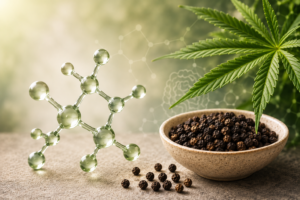
Beta-caryophyllene (BCP) is one of the most clinically interesting terpenes in cannabis because it appears to bridge phytochemistry and the endocannabinoid system in a way that is both mechanistically compelling and potentially useful in practice.(1,2) Unlike most terpenes, BCP directly interacts with the ECS through selective CB2 receptor agonism, giving it a unique role in inflammation, immune signaling, stress physiology, and gut health.(1-3)
For clinicians and patients alike, that matters because BCP may help support a calmer, more tolerable cannabis experience while also offering broader therapeutic potential in inflammatory, gastrointestinal, and anxiety-related conditions.(1,4) At the same time, it is important to keep the evidence in perspective: much of the strongest data remains preclinical, and product-specific claims should be viewed with appropriate clinical caution.(2,4)
Why Beta-Caryophyllene (BCP) is Different
BCP is a dietary sesquiterpene found in black pepper, cloves, hops, and many cannabis chemovars.(1) What makes it different from other terpenes is that it has been identified as a selective agonist of the cannabinoid CB2 receptor, with negligible CB1 activity.(1,3) That distinction is important because CB1 is the receptor most associated with intoxication and psychoactive effects, while CB2 is more closely tied to immune regulation, inflammatory tone, peripheral pain signaling, and gut-immune communication.(1,2)
In practical terms, BCP can be thought of as a non-intoxicating, plant-derived compound that interacts with the ECS in a cannabinoid-like way without producing a cannabis “high.”(1) That makes it particularly appealing for patients who want some of the anti-inflammatory or regulatory benefits associated with cannabinoid signaling but who are sensitive to THC, prone to anxiety, or simply trying to maintain function and clarity.(1,4)
BCP and the Endocannabinoid System
Through CB2 activation, BCP appears to influence several pathways that are highly relevant to clinical care, including cytokine signaling, oxidative stress, neuroinflammation, and nociceptive processing.(1-3) Preclinical studies show that BCP can reduce inflammatory pain, attenuate neuropathic hyperalgesia, and decrease markers of spinal neuroinflammation in CB2-dependent models.(1,3)
This CB2-centered activity also helps explain why BCP keeps appearing in discussions about whole-plant cannabis synergy, especially since it is a major component of Cannabis essential oil derived from the cannabis plant and one of several bioactive compounds discussed in that context.(1,3) While the term “entourage effect” is often used loosely, BCP is one of the more plausible candidates for meaningful pharmacologic contribution because it is not just aromatic; it is biologically active at a cannabinoid receptor target.(1)
Could BCP help Soften THC Overconsumption?
This is where BCP becomes especially interesting from a patient education and harm-reduction perspective.(1,5) There is still limited independent human evidence showing that BCP can reliably reverse or treat THC overconsumption, so it would be premature to describe it as a proven antidote.(4,5) However, there is a reasonable scientific rationale for considering it as a supportive option when a patient is trying to reduce anxiety, discomfort, or loss of control associated with a THC-heavy experience.(1,3,4)
Animal data suggest that BCP has anxiolytic and antidepressant-like effects through CB2-related pathways, and cannabis-facing educational sources frequently describe caryophyllene-rich products as potentially calming in people who are prone to THC-related anxiety or paranoia.(4,5) Mechanistically, that does not mean BCP “cures” intoxication, but it may help support a more manageable physiologic and emotional state during an uncomfortable high.(1,3,4)
That distinction matters. The tone here should remain clinically honest: there is still a lot that is not known, but there is enough mechanistic and early-use rationale to justify discussing BCP as a low-risk, non-intoxicating adjunct in a cannabis safety plan.(1,4,5) BCP is widely consumed in foods and spices, and product developers commonly emphasize that it is generally well tolerated; concentrated consumer products still warrant the same common-sense caution used with any supplement or edible adjunct, especially in people with allergies, polypharmacy, or severe symptoms that need urgent care.(5,6)
A short note on SoftLanding
One consumer-facing example is SoftLanding, which markets itself as a “reverse edible,” meaning a THC-free chocolate intended to help reduce the subjective psychoactive effects of THC rather than intensify them.(5,7) The company describes beta-caryophyllene as its active ingredient and positions the product as a way to “pilot your high,” reduce anxiety and paranoia, support cognitive recovery, and help people feel more comfortable if they have taken too much THC.(5,7)
What makes SoftLanding worth mentioning is not that it is FDA-approved, because it is not, but that it is built around a terpene with a credible ECS mechanism, a favorable ingredient-safety profile, and early pilot data that are encouraging enough to merit further study.(1,5,6,7) On its science page, the company reports that an independent pilot study led by cannabis nurse Jessilyn Dolan, RN found that about 80% of participants considered SoftLanding effective in reducing their high, with an average self-reported decrease in high intensity of about 40%, and an average of roughly two pieces needed to return to a more comfortable level.(7)
Those data are preliminary and self-reported, but they are still clinically interesting because they suggest a signal worth exploring more rigorously rather than dismissing outright.(7) The company also highlights that beta-caryophyllene has been used as a food additive for decades and is on the FDA list of ingredients generally recognized as safe, which supports a reassuring safety discussion even while effectiveness claims remain early.(6,7)
For that reason, SoftLanding can be presented as a thoughtful, BCP-forward harm-reduction option for patients who want something on hand in case a THC experience becomes uncomfortable.(5,7) It should not be described as a guaranteed reversal agent, but it is reasonable to say that it appears to be a safe, practical, and promising product category that aligns with a prevention-first approach to cannabis care.(5-7)
ECS Wellness is supporting the founders of SoftLanding in pursuing a more formalized follow-up study with Institutional Review Board approval because the early pilot findings are promising, the safety profile appears favorable, and the clinical question is highly relevant to real-world cannabis harm reduction.(6,7) A more rigorous IRB-approved study offers the opportunity to move from anecdotal experience and pilot observations toward structured outcomes, clearer methodology, and more credible data that can better inform clinicians, patients, and product development.(7)
GI health and the gut-immune axis
BCP may be especially relevant in gastroenterology-adjacent cannabis care because the ECS plays a major role in gut motility, barrier integrity, immune surveillance, and visceral sensitivity.(1,2) Preclinical and review data suggest that BCP may help reduce intestinal inflammation, oxidative stress, and gut barrier dysfunction, with possible implications for inflammatory bowel disease, gastritis, peptic injury, and obesity-related intestinal dysregulation.(2)
One review of intestinal applications described BCP as a therapeutic alternative in gut disorders because of its anti-inflammatory, antioxidant, and microbiota-modulating effects.(2) Experimental models have also shown improvements in markers such as claudin-1 expression, endotoxemia, and inflammatory tone, which supports the idea that BCP may help stabilize the gut environment rather than only blunt symptoms.(2)
From a clinical lens, that makes BCP interesting for patients who have overlapping GI and stress-related symptom patterns, such as abdominal discomfort, bowel irregularity, bloating, or appetite disruption that worsens when anxiety and inflammation are both in play.(2,4) It should not be presented as a stand-alone treatment for IBD or IBS, but it may be a rational adjunct within a broader lifestyle, nutrition, and cannabinoid-informed plan.(2)
Anxiety and mood regulation
BCP is also relevant to the anxiety conversation because it may support a calmer physiologic response without the intoxication burden associated with increasing THC.(1,4) In mouse models, BCP has produced behavioral effects consistent with reduced anxiety and depression, and these findings appear linked to CB2 signaling.(4)
That does not prove clinical efficacy in humans, but it does offer a credible framework for why BCP-rich profiles are often described as grounding or balancing.(4,5) For patients who are sensitive to the mental side effects of THC, paying attention to terpene composition, especially BCP content, may be one practical way to improve tolerability.(5)
Inflammatory conditions and pain
Because CB2 signaling is so closely intertwined with immune activity, BCP’s anti-inflammatory potential extends beyond cannabis tolerability.(1,2) Preclinical work suggests benefit in inflammatory pain, neuropathic states, and broader inflammatory conditions through reductions in inflammatory mediators and neuroimmune activation.(1,3)
This broadens the conversation from “what helps when THC feels too strong?” to “what cannabis components may support a better therapeutic profile overall?”(1,2) In patients with pain, inflammation, GI dysregulation, or stress-amplified symptoms, BCP may be one of the more useful terpene targets to consider when selecting products or discussing formulation strategy.(1,2)
Clinical takeaway
BCP is not a miracle compound, and it should not be oversold.(2,4) But it is one of the few terpenes with a plausible receptor-based mechanism that connects directly to the ECS, and that alone makes it worthy of more serious attention in cannabis medicine.(1)
The most balanced clinical position is this: BCP appears to be a safe, non-intoxicating, biologically active terpene with meaningful potential in inflammation, GI health, stress physiology, and cannabis tolerability.(1,2,7) There is still much that is not known, especially in human outcome data and product-specific efficacy, but the current evidence is strong enough to justify thoughtful incorporation into patient education, formulation discussions, and harm-reduction planning.(2,4,5)
References
- Klauke AL, Racz I, Pradier B, Markert A, Zimmer AM, Gertsch J, et al. The cannabinoid CB2 receptor-selective phytocannabinoid beta-caryophyllene exerts analgesic effects in mouse models of inflammatory and neuropathic pain. Eur Neuropsychopharmacol. 2014 Aug;24(4):608-20.
- Bento AF, Marcon R, Dutra RC, Claudino RF, Cola M, Leite DFP, et al. β-Caryophyllene: A therapeutic alternative for intestinal disorders? Biomed Pharmacother. 2022;156:113909.
- Bahi A, Al Mansouri S, Al Memari E, Al Ameri M, Nurulain SM, Ojha S. β-Caryophyllene, a CB2 receptor agonist, produces multiple behavioral changes relevant to anxiety and depression in mice. Physiol Behav. 2014 Nov;135:119-24.
- Scandiffio R. A systemic review of beta-caryophyllene. Def Life Sci J. 2024;9:208-20.
- Soft Landing. Home [Internet]. 2026 [cited 2026 Jun 26]. Available from: https://www.getsoftlanding.com/
- U.S. Food and Drug Administration. Generally Recognized as Safe (GRAS) [Internet]. 2024 [cited 2026 Jun 26]. Available from: https://www.fda.gov/food/food-ingredients-packaging/generally-recognized-safe-gras
- Soft Landing. Science [Internet]. 2026 [cited 2026 Jun 26]. Available from: https://www.getsoftlanding.com/science